
Weight loss is changing fast in Sturgeon Bay. New medications are helping people lose weight at a scale we have not seen before. But the number on the scale is not the whole story. What the weight is made of matters just as much, and that is where strength training earns its place. This article explains why keeping muscle matters so much during weight loss, how strength training protects it, and what getting started looks like, even on days when your appetite and energy are low.
Why Muscle Matters More Than the Number on the Scale
Most of the conversation about weight loss stops at the scale. But the scale only tells you how much you weigh… it says nothing about what you lost. Losing fat improves your health. Losing muscle makes everyday life harder. Muscle is what lets you get up off the floor, carry groceries, climb stairs, and catch yourself when you trip. It is also the tissue that keeps your metabolism running and your bones strong as you age. If a large share of the weight you lose is muscle, you can end up lighter and weaker at the same time. That is the outcome nobody wants, and it is exactly what strength training prevents. The goal is not just a smaller number. The goal is a stronger, more capable body at whatever weight you land on.
What GLP-1 Medications Do, and What They Do Not Do
GLP-1 medications work mainly by reducing appetite. You feel full sooner, you think about food less, and you eat less without white-knuckling every meal. That is a real advantage, and for many people it is the tool that finally makes sustained weight loss possible. What these medications do not do is choose what kind of weight you lose. When you eat much less, your body draws energy from both fat stores and lean tissue. Some muscle loss is normal with any significant weight loss. But without a countermeasure, a meaningful share of what comes off can be muscle rather than fat. That is where training comes in. Strength training tells your body to hold on to muscle while the medication and the calorie deficit do their work on fat. The medication opens the door. Training decides what walks through it. One important note: this article is general education, not medical advice. Your prescriber and, if you have one, your dietitian should be part of any decisions about your medication, your nutrition targets, and your training. What follows is the framework we use with people in exactly this situation.
The Two Levers That Protect Muscle: Protein and Strength Training
Two things protect muscle during weight loss, and they work best together. The first is protein. A practical target during active weight loss is about 1.2 to 1.6 grams of protein per kilogram of body weight per day. For a 180-pound person, that is roughly 100 to 130 grams a day. That number can feel unreachable when your appetite is low, so start where you are. Anchor each meal with a palm-sized portion of protein… eggs, Greek yogurt, chicken, fish, beef, tofu, or a shake when solid food feels like too much. Small, steady amounts across the day beat one giant protein-heavy meal you cannot finish. The second lever is strength training. Two to three whole-body strength sessions a week send the signal your body needs: this muscle is still in use, keep it. You do not need long workouts or heavy barbell work to start. Bodyweight movements, dumbbells, and machines all count. What matters is that the work is challenging enough to ask your muscles to adapt, and that it happens consistently. Protein gives your body the raw material. Training gives it the reason. Skip either one and the muscle you are trying to keep has far less protection.
What Getting Stronger Actually Looks Like After 40
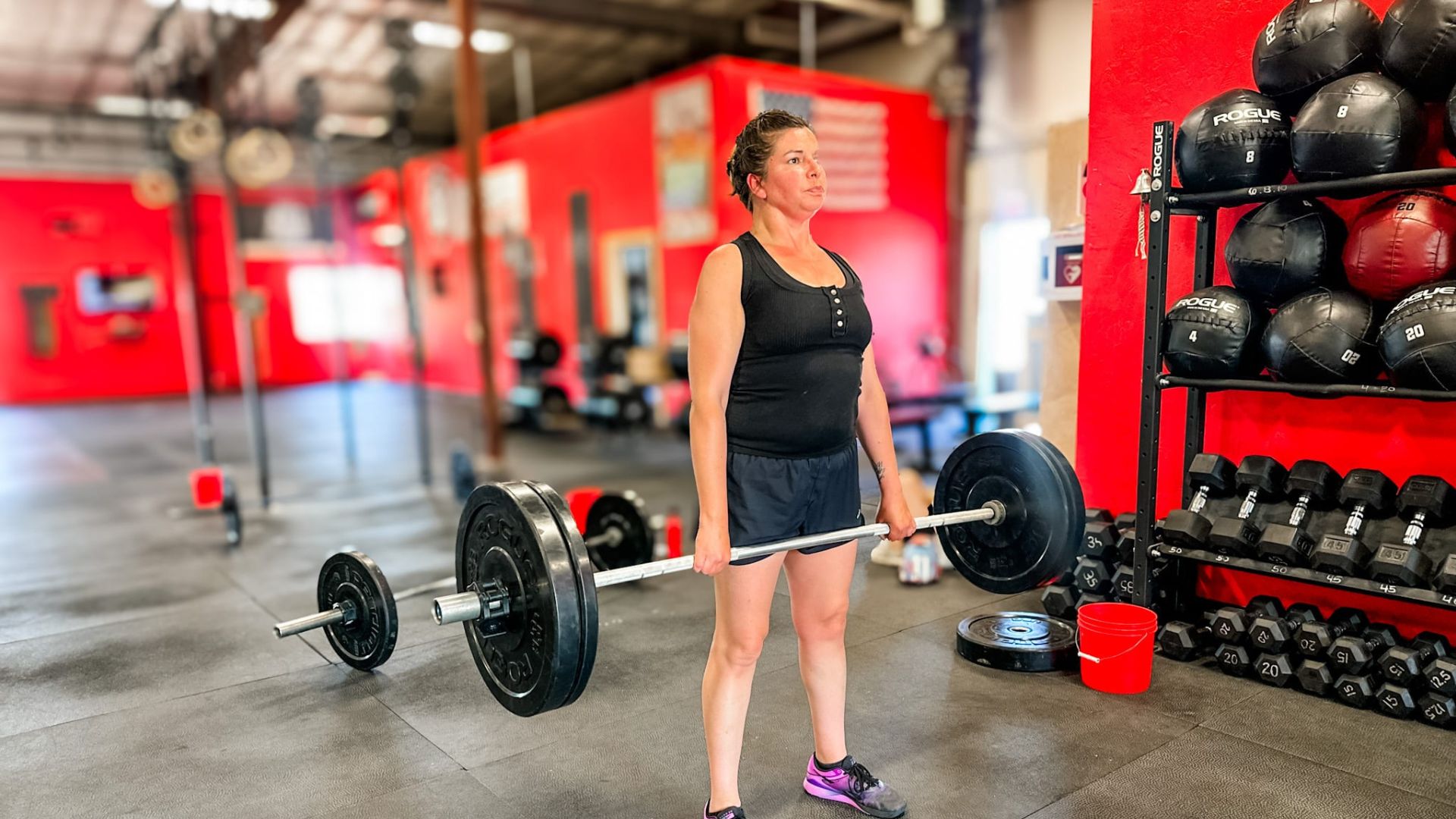
Most people picture strength training as young athletes chasing personal records. That is not what it looks like here. Getting stronger after 40, after 50, after 60, usually looks like this: you learn to squat to a box with good form, you press a dumbbell overhead without your back arching, you carry something heavy across the room and set it down under control. Then you do a little more next week. A little more the week after that. The first changes are often invisible on a scan. Your balance improves. Stairs feel easier. You stop dreading the laundry basket. Measurable strength change typically shows up over six to twelve weeks of consistent training, and it keeps building from there. The people who do best are not the ones who start the hardest. They are the ones who start at a level they can repeat, show up two or three times a week, and let the load climb gradually. That is how a 70-year-old deadlifts her bodyweight. Not overnight. One sensible step at a time.
Coaching Matters More When Your Body Is Changing
Training on a GLP-1 is not the same as training at your old appetite and energy levels. Some days you will feel strong. Some days food has barely happened and your energy is thin. A coach’s job is to read that day and adjust the session to fit it… lighter loads, shorter sets, more rest, a different movement entirely, without losing the thread of the program. That is also where safety lives. As a doctor of chiropractic with a background in physical rehabilitation, I have spent years helping people move well around injuries, limitations, and changing bodies. That background shapes how we coach every session: movement quality first, load second, and scaling that meets you where you are on that day. You are the hero of this story… the person doing the hard work of changing your health. A coach is the guide who keeps the path safe and the progress steady. If you are starting from zero, starting over, or starting with a body that does not feel like yours right now, you do not need a harder program. You need a smarter one, built around you.
How to Start, Even on a Low Day
Start with a conversation, not a workout. A No Sweat Intro is a short sit-down where we talk about where you are, what you are working with, and what a realistic first step looks like. No workout, no pressure, no obligation. From there, most people start with two or three coached sessions a week, built around the basics: squat, hinge, push, pull, and carry. Every session is scaled to you. If you have never touched a barbell, you will not start with one. If your knees complain, we find the version that does not. If your energy is low that day, we adjust the session down and keep you moving. That adjustment is not a failure. It is the program working as designed. On a low-energy day, the win is showing up and doing the scaled version. On a good day, the win is a little more load or one more round. Over weeks, those wins stack into strength you can feel in daily life. The only requirement is that you start. We will handle the rest, one session at a time.
Your Next Step in Sturgeon Bay
The medication is doing its part. Now give your body a reason to keep the muscle that keeps you independent. Strength training is not about becoming an athlete. It is about staying the person who can do what they want, when they want, for as long as possible… strong, capable, and independent — at 80, not just at 50. If you live in Sturgeon Bay or anywhere in Door County and you are losing weight, whether on a GLP-1 or not, come talk to us. A No Sweat Intro takes about 20 minutes. We will listen, answer your questions, and map out a first step that fits your life right now. Hold the standard. Book a No Sweat Intro and start with a conversation.
Sources
- Mozaffarian D, et al. Nutritional priorities to support GLP-1 therapy for obesity: a joint advisory from the American College of Lifestyle Medicine, the American Society for Nutrition, the Obesity Medicine Association, and The Obesity Society. Obesity. 2025;33(8):1475-1503. The advisory proposes 1.2 to 1.6 grams of protein per kilogram of body weight per day during active weight loss, and names adequate protein plus strength training as priorities for preserving muscle and bone during GLP-1 therapy.
- Wilding JPH, et al. Once-weekly semaglutide in adults with overweight or obesity (STEP 1). New England Journal of Medicine. 2021;384:989-1002; and the STEP 1 exploratory body-composition analysis (Journal of the Endocrine Society. 2021;5(suppl 1):A16). In the DXA substudy, fat mass fell 19.3% and lean body mass fell 9.7% over 68 weeks, with lean mass making up roughly 40% of the weight lost.
- Longland TM, Oikawa SY, Mitchell CJ, Devries MC, Phillips SM. Higher compared with lower dietary protein during an energy deficit combined with intense exercise promotes greater lean mass gain and fat mass loss: a randomized trial. American Journal of Clinical Nutrition. 2016;103(3):738-746. Higher protein combined with resistance training preserved and built lean mass during a steep energy deficit.
- Ratamess NA, et al. American College of Sports Medicine position stand: progression models in resistance training for healthy adults. Medicine and Science in Sports and Exercise. 2009;41(3):687-708. Background on how strength and muscle respond to progressive resistance training over time.


